
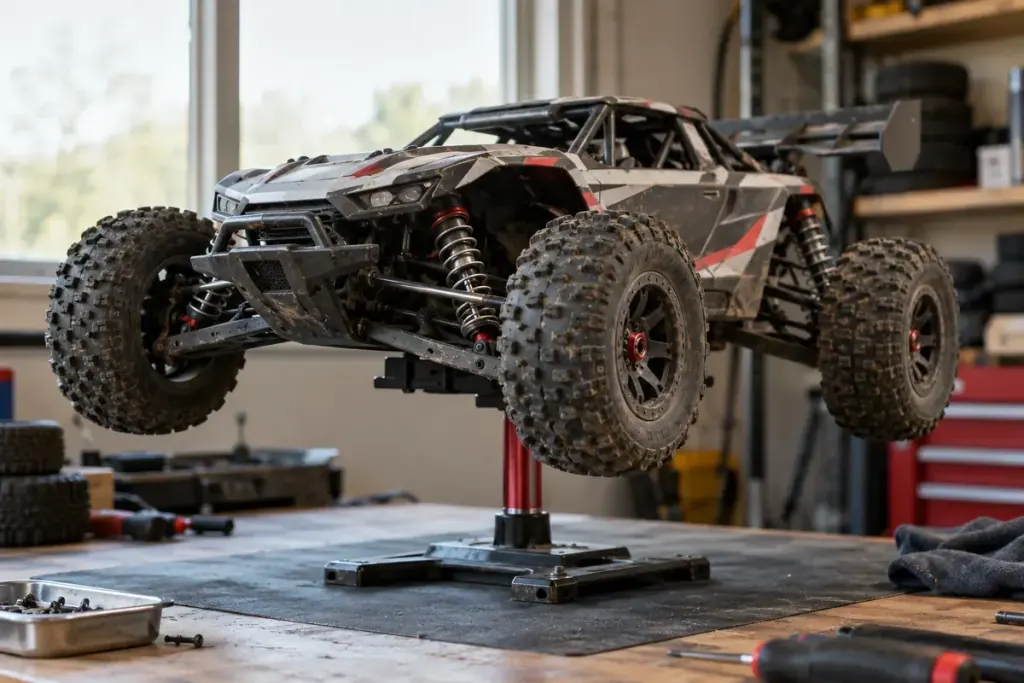
Lift an RC car by its chassis and the wheels move down before they leave the bench. That downward extension is related to suspension droop. It is a different observation from the car’s ride height while resting on its tyres.
Use the measurement method for the chassis
Setup guides may measure droop at different reference points and with particular blocks or gauges. XRAY’s NT1 setup book is one model-specific example. Its numbers should not be copied onto an unrelated buggy or touring car.
Read whether the procedure requires wheels, shocks or anti-roll bars to be fitted or disconnected. A measurement taken under different conditions may look comparable while describing a different state. Record the method with the value.
Check free movement before adjusting
Binding links, damaged parts or a tight driveshaft can limit movement. Do not compensate for a fault by turning a droop screw further. Inspect according to the manual and make sure left and right sides move as intended.
On a design with adjustable droop stops, work in small documented steps and recheck related settings. Do not assume the same adjustment mechanism exists on every chassis. Spring preload, ride height and droop interact with the setup but are not interchangeable labels.
For a track comparison, change one setting and note the surface, tyres and driving conditions. Avoid claiming that “more droop is always more grip”; handling depends on the whole vehicle and the situation.
Keep the original baseline so you can return to it. A useful note identifies the car, gauge, measurement point and observed handling change. The purpose is to make the suspension’s available movement understandable and repeatable, not to chase a setup number borrowed from a different car’s winning result.