
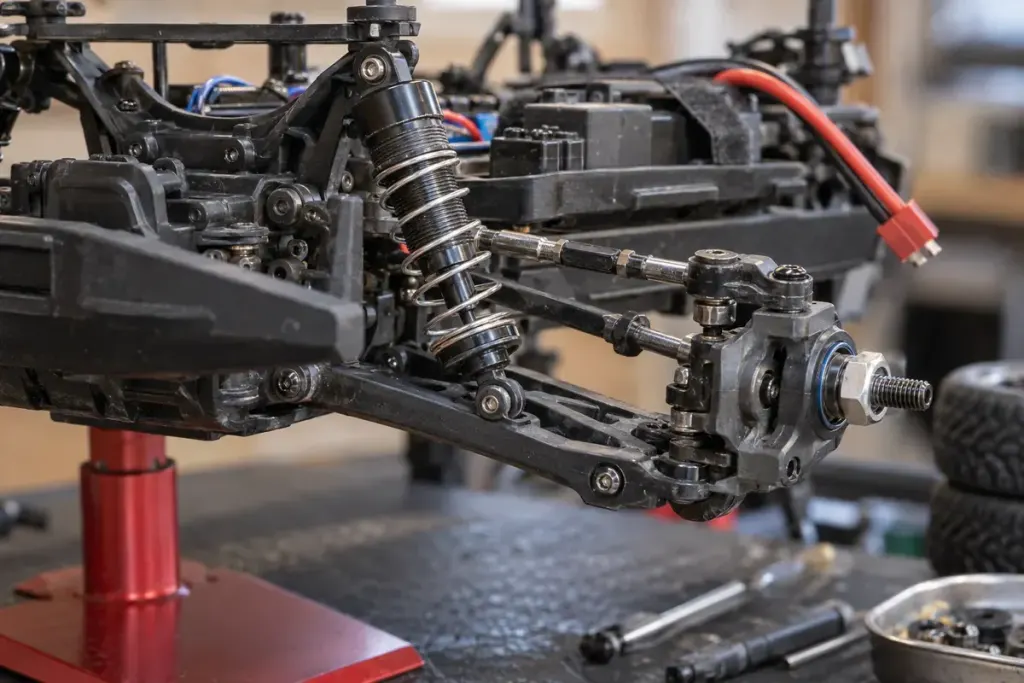
A setup sheet lists caster, camber and toe together, but the three terms describe different geometry. Caster concerns the steering axis as viewed from the side of the vehicle. It is not simply another name for a wheel leaning inward when viewed from the front.
With positive caster, the upper part of that steering axis is inclined rearward relative to its lower part. Camber describes the wheel’s inward or outward inclination from the front, while toe describes the direction the wheels point when viewed from above. Keeping the viewpoints separate makes a suspension diagram much easier to read.
Find the model’s adjustment method first
The Traxxas Mustang drift car manual provides a model-specific example of caster adjustment through front suspension positioning. Its settings belong to that chassis. They should not be transferred automatically to a different car with different parts and geometry.
Before touching a setting, identify the relevant pivots and adjustment parts in your own manual. Disconnect the drive battery and support the chassis securely. Photograph the original arrangement and record the starting setting, including any spacers, so that returning to the baseline does not depend on memory.
Change one variable and observe a complete corner
Caster contributes to steering behaviour, including how the geometry changes as the wheels turn. Its effect interacts with other suspension dimensions, tyres and surface conditions. A larger number is not a universal upgrade, and a single fast turn does not establish which setting is best.
After an approved adjustment, check free movement through steering and suspension travel. Look for interference or binding before running the car. Recheck the associated alignment settings specified by the manufacturer rather than assuming they stayed unchanged.
On a safe practice area, compare entry, mid-corner response and return toward straight ahead under similar conditions. Write down what changed in observable terms. “Needed less correction on exit” is a more useful note than “felt professional,” especially when deciding whether to keep the adjustment or restore the original setup.