
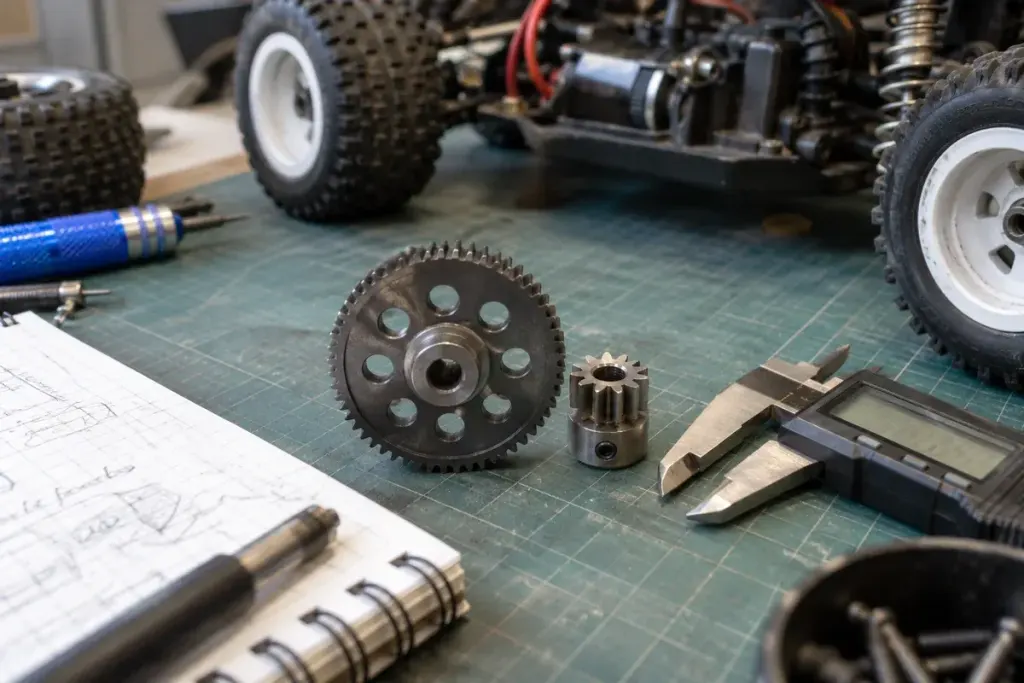
A gearing change promises more speed, but the result depends on more than two gear sizes. Tyres, terrain, vehicle weight, battery and driving style all affect the load. Before changing anything, write down the existing setup and establish how the car behaves in ordinary use.
Keep the model, motor and speed-controller manuals nearby. Manufacturer limits apply to the actual components in the car; a temperature mentioned for another model is not a safe universal target.
Record a baseline you can reproduce
Note the pinion and spur tooth counts, tyre choice, battery specification, surface and approximate run duration. Record ambient conditions and any existing binding or drivetrain issue. A comparison is weak if the first run is on smooth ground and the next is through long grass.
Inspect the drivetrain before treating gearing as the explanation for heat. Friction, damaged bearings or incorrect mesh can also matter. Fix a mechanical problem before experimenting with a different ratio.
Change one variable within the permitted range
Use only combinations and components appropriate for the vehicle. Follow the manual for gear mesh, fasteners and installation. The Traxxas model 67376-4 manual discusses temperature monitoring and gearing, illustrating why a ratio change needs observation. Its model-specific figures should not be transferred to unrelated equipment.
After the change, make a short, conservative test and check temperatures using an appropriate instrument and the manufacturer’s procedure. Do not use touching a hot motor as your measurement method. Stop before approaching applicable limits, and allow components to cool as instructed.
Write down more than the fastest number
Useful notes include acceleration, braking feel, responsiveness, temperature observations and whether the run was comparable. An illustrative record might say that a taller setup felt quicker on a straight but heated more during repeated starts. That observation is more informative than a single speed claim.
If you cannot make a fair comparison, say so and retain the safer known setup. Do not extend a test merely to obtain a dramatic result. A gearing notebook helps you recognise which setup suits a particular surface and style of driving. It does not turn every model into a speed-run vehicle or remove the need to respect component limits.