
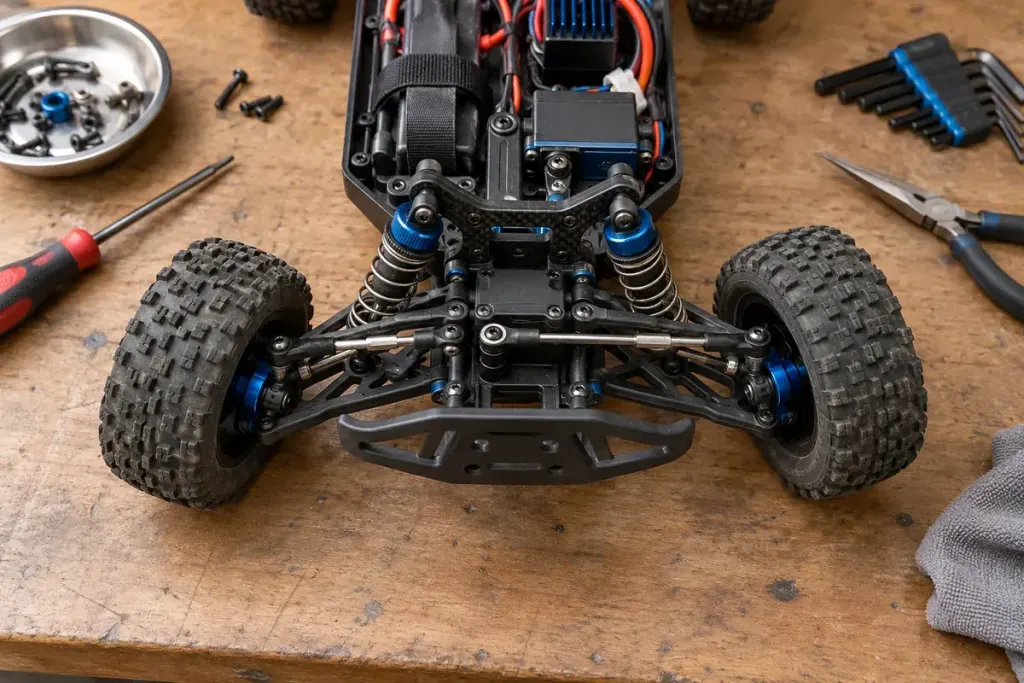
Turn an RC car’s front wheels and the inner wheel may point farther into the corner than the outer one. That difference can be intentional. The wheels follow different-radius paths, so identical angles are not automatically the target.
Team Associated’s tuning guide describes Ackermann as the inside front wheel turning more tightly than the outside one. Its specific adjustment examples belong to that model; they should not be copied blindly to another chassis.
Observe before adjusting
With the model safely secured and following its power and setup instructions, compare the steering positions. Identify the inner and outer wheel for each turn. Look for symmetry between left and right turns, while remembering that each pair need not have equal angles within one turn.
Check the manual’s linkage lengths, mounting holes and baseline setup. A changed steering plate or misplaced spacer can alter geometry, while binding or damaged parts can create a separate problem.
Change one documented setting
If the model supports an Ackermann adjustment, record the original position before changing it. Check free movement through the intended range without forcing the servo or linkage. Use the manufacturer’s endpoint and safety procedures.
Then evaluate on a suitable controlled driving area, keeping tyres and other setup variables consistent. One change may affect corner entry differently from the rest of the turn; avoid judging it from a single dramatic slide.
Do not try to make the wheels look parallel at full lock merely because the unequal angles appear untidy. Conversely, do not explain every steering irregularity as Ackermann. Damage, incorrect assembly and interference still need checking.
A useful setup note records the model, part configuration, adjustment and observed behaviour. The geometry has a purpose, and a good adjustment begins by understanding which part of that purpose your particular car is designed to serve.