
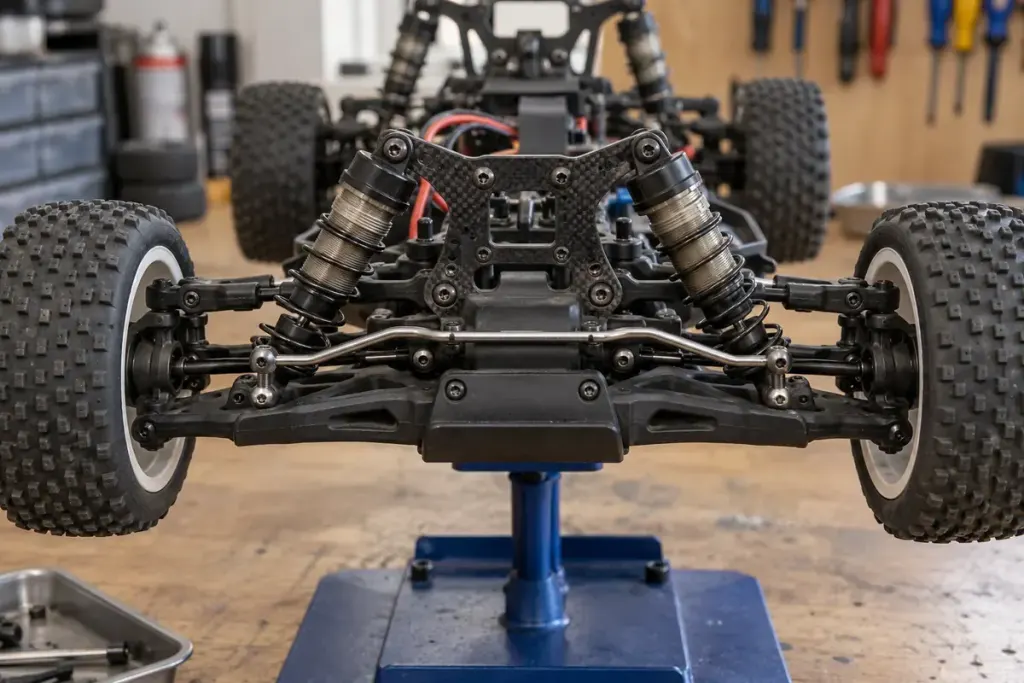
An anti-roll bar connects the suspension across an RC car. When the two sides move differently, the bar twists and resists part of that difference. Its effect is therefore tied to how the chassis rolls and how the suspension shares load.
It is not a replacement for the springs or dampers, and fitting the stiffest available wire is not automatically an upgrade.
The XRAY X4 2022 manual shows a model-specific anti-roll-bar installation and checking procedure. Its setup notes also illustrate how a stiffness change can alter handling rather than simply making every aspect of grip better.
Check the installation before tuning
Place the car on a stable stand with power disconnected. Follow the model’s instructions for checking links, mounting play and free movement. Binding, an incorrectly centred bar or unequal link adjustment can confuse any later handling comparison.
Do not copy another chassis’s dimensions or screw settings. The bar’s shape, mounting points and linkage geometry are part of the system. Even wires with the same nominal diameter can behave differently in different installations.
Once the baseline is correct, record the front and rear bar specifications along with tyres, springs, ride height and surface conditions. Change one relevant setup item at a time so the next run answers a clear question.
For example, an illustrative test note might read: “Same tyres and track conditions; changed front bar only; compare initial steering and corner exit.” It should not begin with a conclusion such as “more grip” before the car has been driven.
Use a safe practice area and repeat a consistent section at a controlled pace. A single fast lap or one crash is not enough to distinguish a setup effect from driving variation.
If the car behaves unexpectedly, return to the known baseline and inspect for damage or binding. Tuning around a bent link can produce a complicated setup that merely disguises a mechanical fault.
The useful role of an anti-roll bar is specific and adjustable. Understanding the connection across the car makes the next change a testable handling decision rather than an accessory purchase based on appearance.