
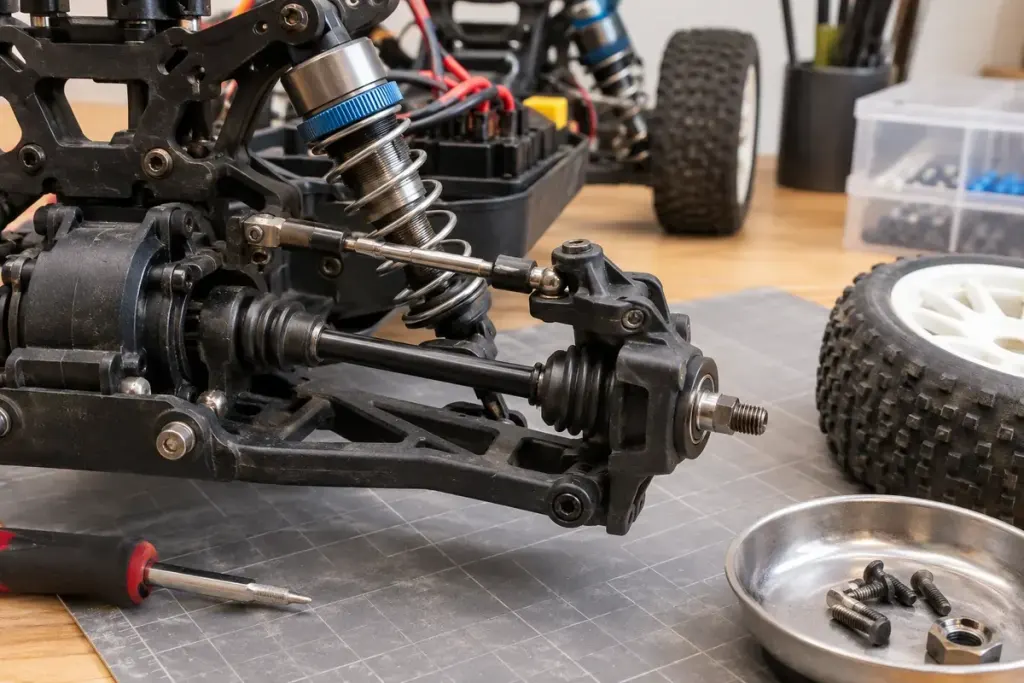
A wheel turns freely with the suspension resting in one position but feels tight when the arm moves. The driveshaft deserves attention alongside the bearings and gears. A dogbone-style joint must transmit rotation while allowing the surrounding geometry to change.
Start with the manufacturer’s manual and parts list for the exact model. XRAY’s XB4 manual, for example, identifies different shaft lengths for different arrangements. It illustrates why a part that looks almost right is not automatically the correct replacement.
Inspect with the car safely unpowered
Disconnect the drive battery and follow the manual’s workshop precautions. Examine the shaft, pins and drive cups for visible damage or unusual wear. Compare the part number with the intended installation rather than measuring only the overall length by eye.
Move the suspension through the permitted range by hand, as the manual allows, and observe whether the shaft remains correctly engaged without forcing the joint. If resistance appears, stop and identify its source. Do not use motor power to push through a mechanical bind.
Check whether recent changes to arms, hubs, travel limits or other parts altered the geometry. A symptom that began after a modification gives you a useful starting point, although it does not prove which component is responsible.
Use the specified assembly details
Washers, spacers, retaining parts and lubrication requirements are model-specific. Do not pack a drive cup with improvised material simply because another owner’s different car uses a similar-looking arrangement.
After an approved repair, repeat the unpowered movement check before a cautious operational test in an appropriate area. Keep the replaced part number and the observed symptom in your setup notes.
The aim is a drivetrain that remains free through its intended movement, not merely a wheel that spins when the car sits in one convenient position on the bench.