
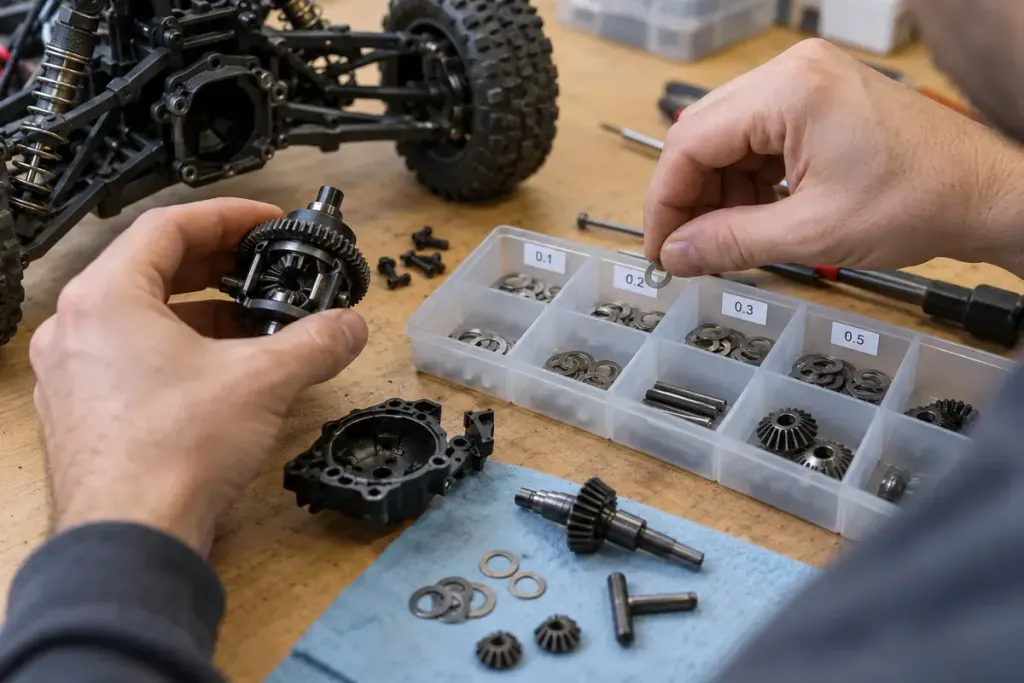
A thin washer sticks to an oily gear, falls onto the bench and suddenly has no obvious home. During RC differential maintenance, keeping track of small parts is often more valuable than working quickly.
Identify the assembly first
Find the exploded view and service information for the exact vehicle, version and differential. Front, rear and centre assemblies can differ. A diagram for a similar-looking model is not enough to establish the number or location of shims.
Manufacturers provide model-specific parts information; for example, Traxxas’ maintenance guidance explains where to find model-specific manuals, parts lists and exploded views. Use the equivalent official documentation for your vehicle rather than assuming a generic online rebuild applies.
Make the bench preserve the order
Disconnect the battery and follow the model’s maintenance instructions before disassembly. Work over a clean tray with separate spaces for each stage. Photograph an assembly before removing the next layer, and label left and right only after choosing a consistent viewing direction.
Look for small parts that remain attached by grease. Do not wipe everything into a single cloth before identifying it. A photograph can document what you found, but an incorrectly assembled vehicle can also be photographed; compare the record with the official diagram.
Do not solve uncertainty by adding washers
A shim’s thickness and position are part of the assembly specification. Adding an arbitrary washer to remove movement can create a different problem. Follow the manufacturer’s procedure and tolerances, or ask a knowledgeable service technician when the documentation does not resolve the question.
During reassembly, use the specified lubricant, fasteners and tightening guidance. Check movement as directed before returning the vehicle to powered operation. Binding, unexpected play or an unexplained leftover part is a reason to stop and investigate.
Keep the diagram and your labelled photographs with the model’s maintenance record. The next service becomes easier when the previous one leaves a clear trail instead of a memory of where a tiny ring probably belonged.