
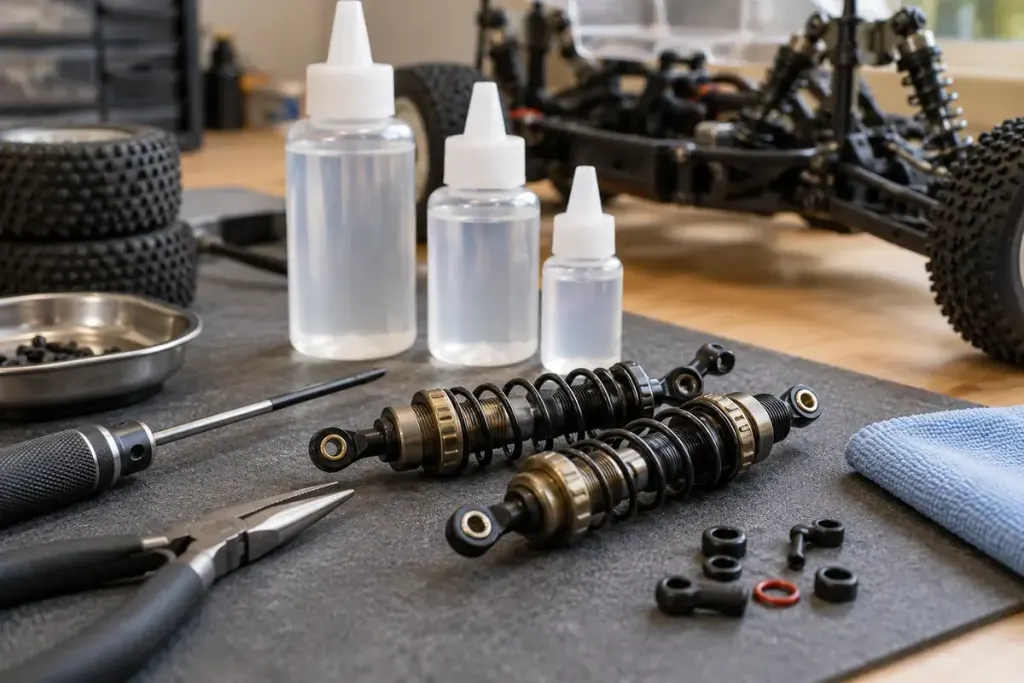
Two bottles have similar colours and different numbers. That is not enough information to decide which belongs in your RC shocks. Start with the model’s manual and the oil’s stated application and viscosity.
Traxxas’s oils and lubricants guide distinguishes products for different jobs, while its shock-absorber guide explains oil as part of damping. These are manufacturer references, not proof that one product is compatible with every model.
Keep the units and product family visible
Some labels use a weight designation and others provide a viscosity value such as cSt. Do not assume similarly named weights from different brands are directly equivalent. Use the manufacturer’s comparison information where available and keep the exact product name in your setup notes.
Shock oil and differential oil can appear beside each other in a hobby shop. Check the label and intended application before opening a bottle. Packaging colour is a poor substitute for reading the product information.
Change one variable you can evaluate
Record the existing oil, piston arrangement, springs and any relevant setup details before maintenance. Follow the model’s instructions for disassembly, filling and bleeding. Keep components clean and dispose of used material appropriately.
If tuning, alter one planned variable and test under comparable conditions. A different surface, temperature or tyre setup can change the result, so note those differences instead of attributing everything to the oil.
Observe what the car does: repeated bouncing, bottoming or a change in how it settles after an obstacle. Those observations are more useful than declaring one viscosity universally faster.
Return to the documented baseline if the result is worse or unclear. A labelled bottle and a short setup record make that possible. The aim is a suspension setting you understand and can reproduce, not a collection of untraceable mixtures left in the dampers.