
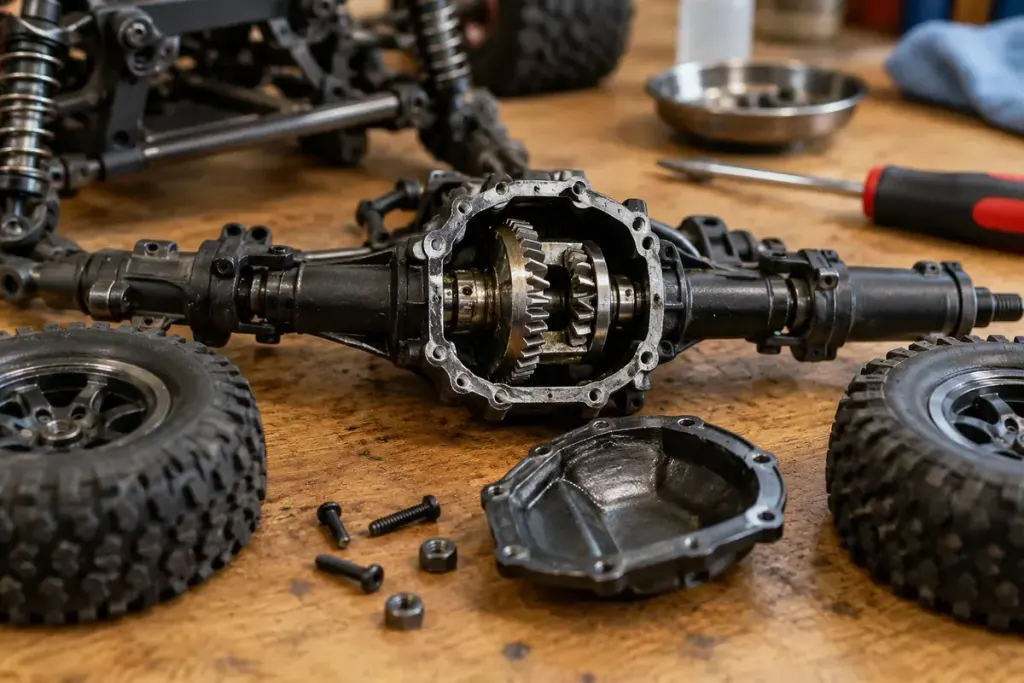
When an RC car turns, the outside wheel follows a longer path than the inside wheel. A differential allows the driven wheels to rotate at different speeds while the drivetrain supplies power. That freedom is part of the mechanism’s purpose, not automatically a sign that one wheel has become disconnected.
The Traxxas model manual describes the differential’s role and the use of fluid in some RC designs to influence how independently the wheels turn. Exact construction varies: do not assume every model has the same gear arrangement, fluid specification or adjustment method.
Start with the model’s exploded view
Locate the differential in the manual and identify the surrounding driveshafts, bearings and outputs. Knowing which component connects to which wheel is more useful than opening the assembly merely because a wheel behaves differently while the car is lifted.
Observe a suspected problem with power disconnected and the vehicle supported safely, following the manufacturer’s maintenance instructions. Do not hold fingers near rotating wheels or gears under throttle to diagnose a noise. An unloaded wheel test may behave differently from driving on the ground.
Record the actual symptom: clicking, binding, leakage, unusual resistance or loss of drive. Include when it occurs and whether the car recently suffered an impact or was serviced. That description helps distinguish a differential concern from a loose wheel attachment or another drivetrain issue.
If maintenance is required, use the specified parts, lubricant and assembly procedure. Changing fluid thickness or locking behaviour is a setup change with handling consequences, not a universal repair for every complaint. Change one planned variable at a time and keep a record so you can return to the previous setup.
A differential makes a simple-looking axle behave intelligently through a turn. Understanding that basic purpose helps you avoid “fixing” normal wheel-speed differences while still noticing genuine changes in sound, smoothness or drive.