
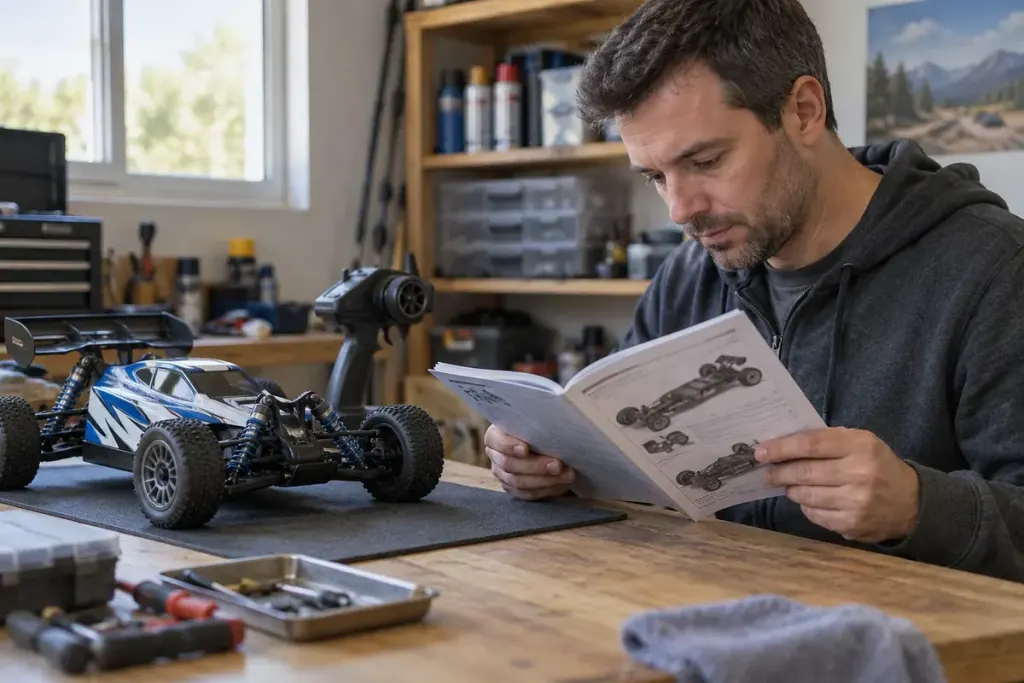
An RC failsafe is easy to overlook while the radio link is working normally. Its purpose becomes relevant when something goes wrong, which is why the expected behaviour should be understood before a run rather than discovered beside a moving vehicle.
Use the manuals for the actual transmitter, receiver and vehicle. Different combinations can handle signal loss, low voltage and throttle behaviour differently. A procedure demonstrated for another model is not automatically safe or appropriate for yours.
Identify what the system is meant to do
Find the manufacturer’s description of the failsafe and any required setup. Note which condition it covers and what response is expected. Do not assume that a feature protecting against loss of signal also protects against every mechanical or electrical fault.
If the radio equipment has been changed, check compatibility and repeat the prescribed setup before ordinary use. A vehicle that steers correctly on the bench may still have an unresolved configuration issue.
Follow the specified test environment
Carry out only the test described for the model, with the vehicle secured and people clear as instructed. Do not improvise by switching equipment off around a powered vehicle on the ground. Electric and combustion models can require different precautions.
If the result does not match the manual, stop and investigate through the manufacturer or a competent specialist. Repeating a risky test at greater throttle does not make the diagnosis more useful.
Record the radio model, setup date and result in the maintenance notes. Revisit the instructions after changes to the receiver, transmitter, speed controller or relevant firmware. Keep routine mechanical checks too: a failsafe cannot tighten a loose wheel or repair a binding linkage.
The valuable outcome is knowing what your particular system will do under its stated conditions, and having a documented safe check. Confidence based on a model-specific result is more useful than assuming every radio set responds the same way.