
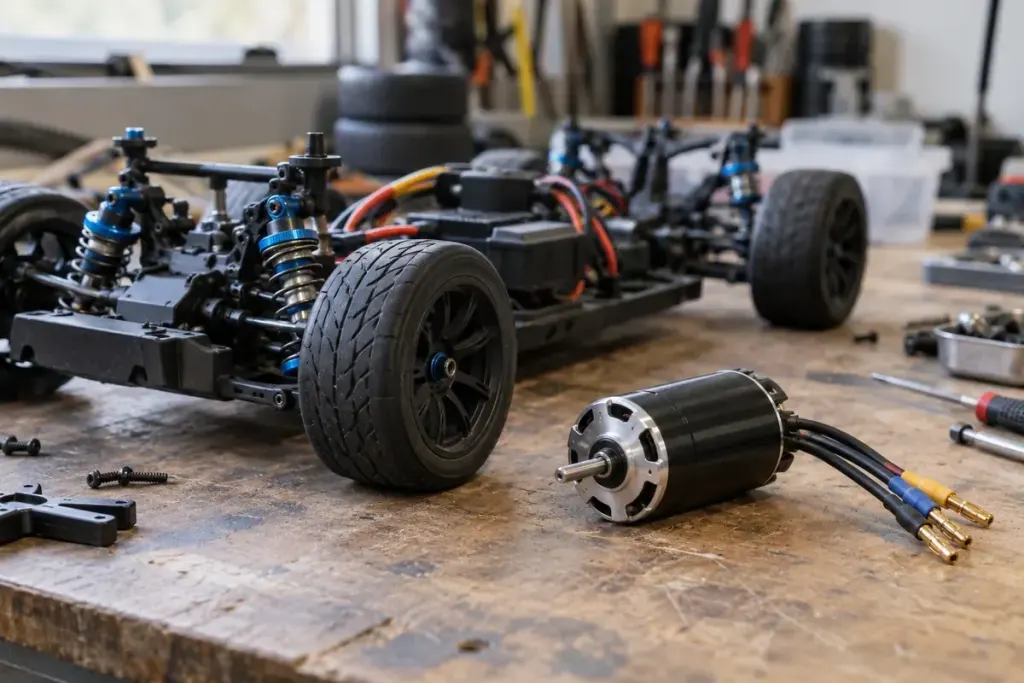
Two brushless RC motors have the same KV figure but very different dimensions and recommended applications. The matching number does not make them interchangeable.
In this context, KV is a motor speed constant, commonly expressed as revolutions per minute per volt. Castle Creations’ technology explanation describes that relationship. It is not a power rating in watts.
Use the number for the question it answers
As a simplified calculation, multiplying a hypothetical 2,000 KV rating by 10 volts gives 20,000 revolutions per minute under an idealised no-load interpretation. This is an explanation of the unit, not an instruction to connect that voltage or spin a motor on a bench.
A vehicle places a load on the motor. Its actual behaviour also depends on the battery, controller, gearing, tyres, vehicle mass and operating conditions. The simple calculation does not predict road speed, current draw or temperature.
Likewise, two motors with equal KV can differ in construction and permitted operating limits. Comparing only that figure leaves out information needed to judge whether either motor belongs in the vehicle.
Read the combination, not one component
Before a replacement, gather the vehicle’s motor-space and mounting requirements, the controller’s compatibility information, and the motor manufacturer’s approved voltage and application guidance. Check shaft dimensions and the intended gearing as well as the headline specification.
Keep those details in a comparison note. A column headed “same KV” should not substitute for separate entries about fit, controller compatibility and manufacturer limits. If the required information is absent, ask the supplier rather than treating the missing limit as unrestricted.
Follow the specific operating instructions during setup. Do not free-rev an unloaded motor to see whether the calculated speed looks right. Castle’s 1721 motor usage information, for example, includes explicit restrictions on unloaded operation.
KV is useful once it is placed among the other specifications. It helps describe a motor’s speed characteristics; it cannot, on its own, promise a faster, cooler or more durable RC vehicle.