
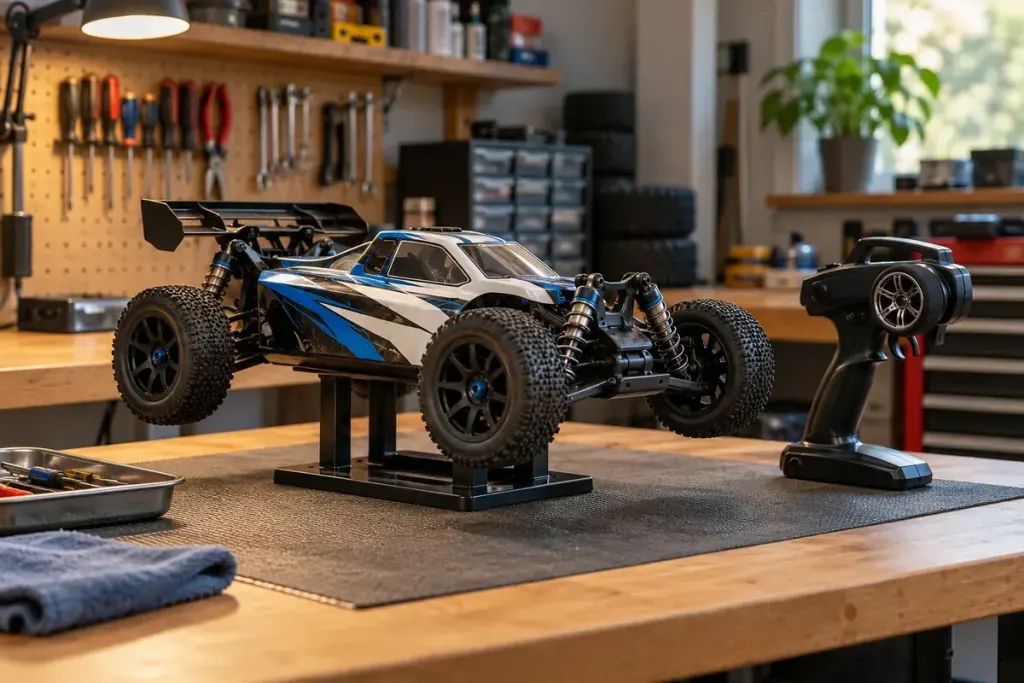
An RC car’s electronic speed controller needs to interpret the transmitter’s neutral, full-throttle and braking signals correctly. Calibration establishes that relationship. It does not repair a damaged motor, weak battery connection or mechanical drivetrain fault.
Begin by identifying the exact controller and radio system. A button sequence remembered from another model can change a different setting or fail to establish the intended throttle range.
Read both sides of the connection
The Traxxas manual for model 77096-4, for example, includes a specific procedure for its VXL-8s controller. That is an example of model-specific documentation, not a universal sequence for every ESC.
Check the required transmitter trim, endpoints, direction and any throttle-related assistance settings before starting. Use the values specified by the manufacturer. Changing them after calibration can alter the signals the controller receives.
Prepare a safe working area and follow the manual’s precautions against unexpected movement. Keep wheels and moving parts away from hands, clothing and loose objects. Do not begin with the vehicle pointing towards people or a fragile surface.
Confirm the result without a full-speed surprise
Follow the documented sequence and interpret the lights or tones using the correct manual. A light changing colour is not sufficient evidence if you do not know which mode it indicates.
Afterwards, carry out the manufacturer’s prescribed checks for neutral, forward response, braking and failsafe behaviour. Use a controlled environment and stop if the response is unexpected. Repeatedly adding throttle is not a diagnostic method.
Record the transmitter profile and relevant settings alongside the controller model. If the radio or throttle configuration changes later, consult the instructions about whether recalibration is required.
Keep calibration separate from performance tuning. Establishing a correct signal range should come before experimenting with acceleration or braking settings. A dependable baseline makes later adjustments easier to understand and helps prevent one change from masking another fault.