
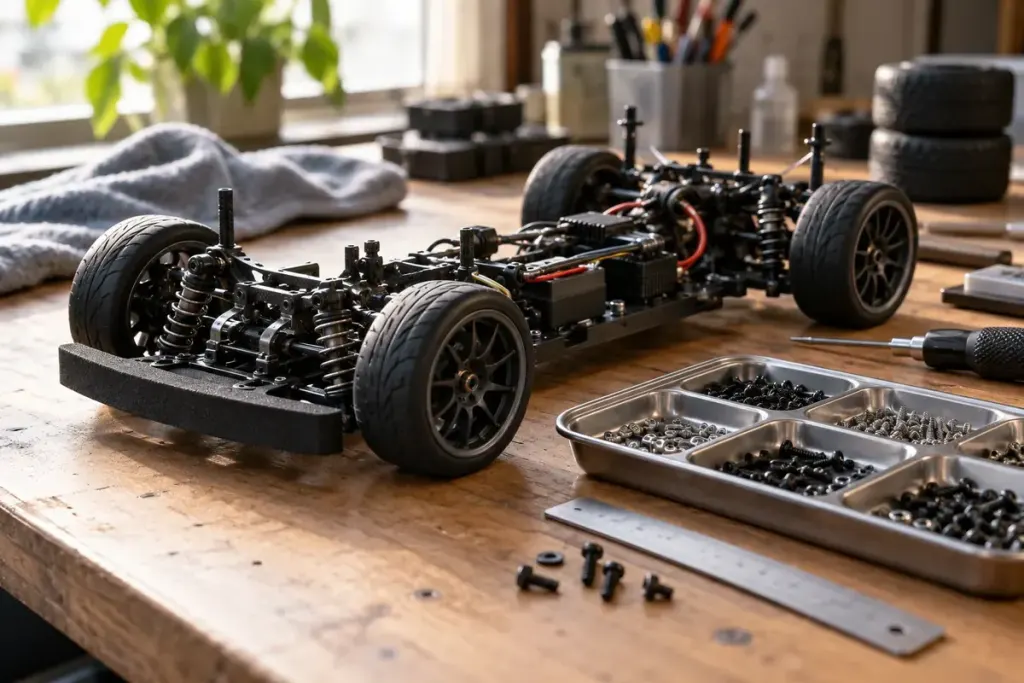
A screw fits the driver and begins threading into an RC chassis, so it seems like the right replacement. Its tip may still extend farther than the original and reach a moving part or another component. Matching the tool size is only the start of identifying a fastener.
Use the model’s parts information
Find the exploded diagram or maintenance instructions for the exact model and revision. Check length, thread type, diameter and head style. Similar-looking screws can belong to different mounting points, and a previous owner’s installed screw is not proof of the correct specification.
Prepare a tray with labelled positions as parts are removed. A photograph can help show where fasteners came from, but it should supplement the manufacturer’s information rather than replace it.
Compare what extends beyond the mounting part
With the model safely powered down and the battery disconnected according to its instructions, inspect the mounting arrangement without forcing parts. Consider the thickness of the pieces the screw passes through and the space behind them. Do not assume a blind hole can accept any extra length.
For an illustrative assembly, two screws share a thread and head but differ by several millimetres. One belongs through a thicker bracket. Moving it to a thinner bracket can leave more of its tip projecting behind the mounting surface.
Stop when resistance does not feel expected
Do not use extra force to make an uncertain screw seat. It may be bottoming out, cross-threading or contacting something behind the part. Remove it and check the specification and alignment. Follow the manufacturer’s torque and thread-locking instructions where provided; neither should be guessed from a general guide.
After reassembly, perform the model’s prescribed checks before operating it. Look for interference through the intended range of movement while the system remains safely unpowered. If the correct fastener or procedure is unclear, ask the manufacturer or a qualified model technician.
Keep replacement screws identified in their packaging. A small organised stock saves time, but an unlabelled box of almost-matching fasteners can make a simple repair harder to verify.