
The RC car is cleaned and the transmitter is switched off, but the battery is still connected inside the chassis. Packing away the model is not quite the same task as preparing the battery for storage.
A repeatable end-of-session routine helps prevent guesswork at the next outing. Start with the instructions for the exact battery, charger and vehicle rather than a general rule borrowed from another chemistry.
Identify the pack and its approved equipment
Keep the battery label readable and confirm the chemistry, cell count and compatible charging arrangement. A connector that fits does not establish that the charger settings are correct. Use the manufacturer’s approved equipment and procedures.
Traxxas’s model manual and battery precautions illustrate why LiPo use and charging require specific safeguards. That manual applies to its stated products; use your own equipment’s documentation for settings and compatibility.
Check condition before charging or storing
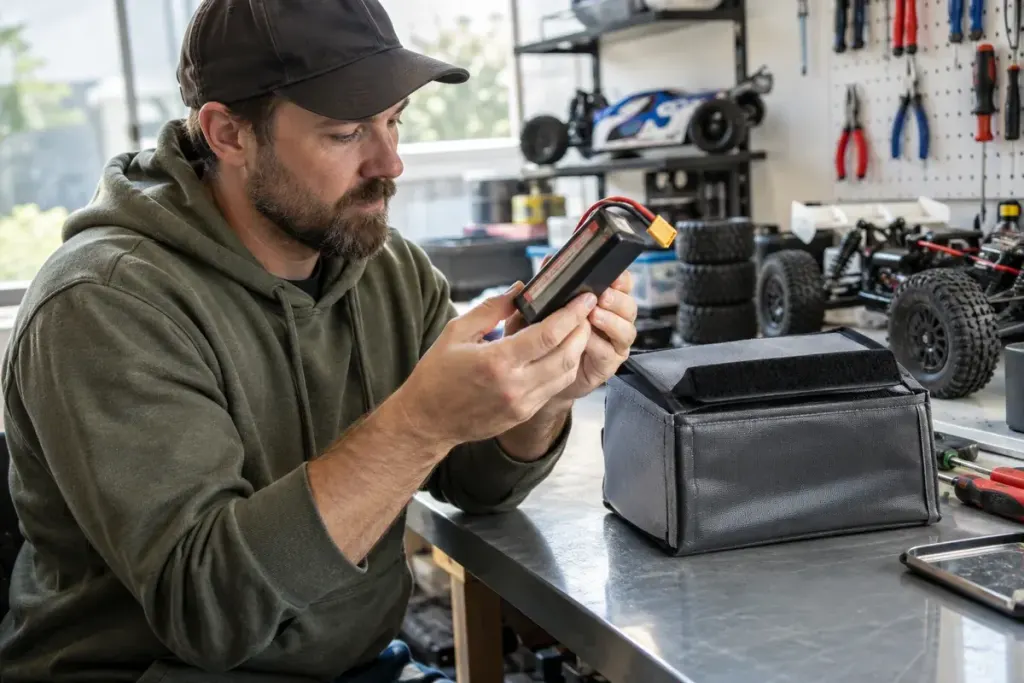
Inspect the pack, leads and connectors as directed. Stop using a swollen, damaged or otherwise abnormal battery and contact the manufacturer or a qualified service provider for handling advice. Do not puncture, rebuild or attempt to revive it.
Let a pack cool as instructed before charging. Charge only in the approved setting, away from combustible material, and never leave charging unattended. A protective container is not permission to ignore the process.
Use the specified storage procedure
For packs requiring a storage-charge state, use a compatible charger’s appropriate function in accordance with both manuals. Do not guess a voltage or apply LiPo advice to every battery type. Disconnect and remove the battery from the model when the instructions require it.
Choose a storage location that meets the manufacturer’s temperature and safety guidance and keeps the pack away from children, pets and conductive objects. Follow its recommendations for periodic checks during longer storage.
Leave a note for the next session
A small record can identify the pack, last use, storage preparation and any concern noticed. This is especially useful when several similar packs share the same case. It prevents “I think that one is ready” from becoming the charging plan.
Use an approved local battery-recycling or hazardous-waste route when a pack reaches the end of its life; obtain specific guidance for damaged batteries. Do not place it in ordinary rubbish. Looking after the battery is part of the hobby’s workshop routine, just like checking wheels and fasteners before the model returns to the track.