
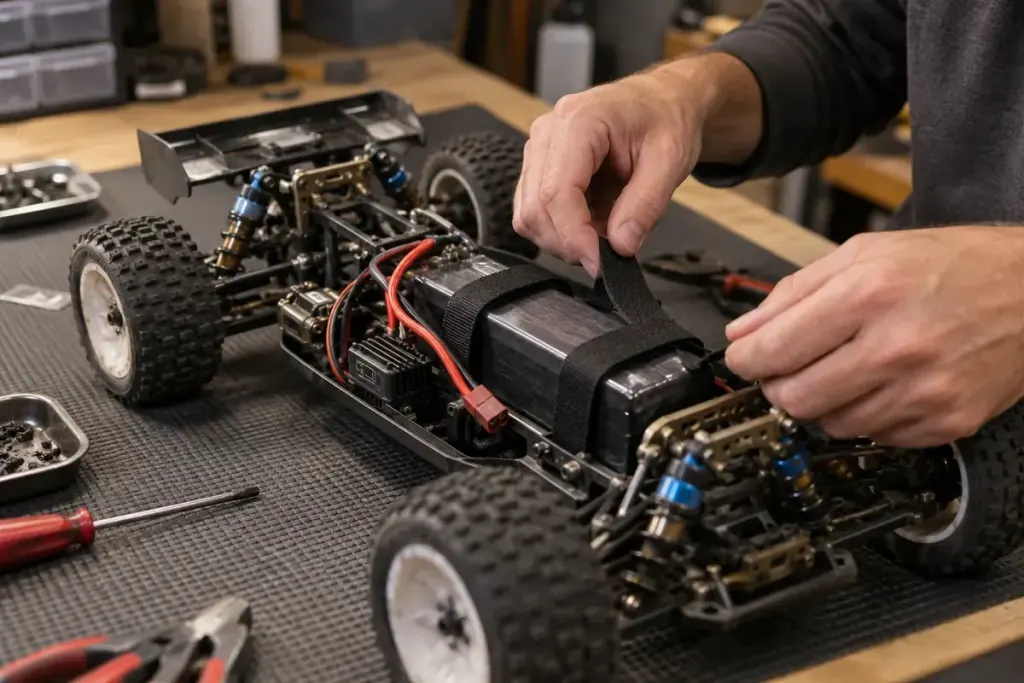
A battery that fits inside an RC vehicle’s tray is not automatically secured for driving. The retaining strap or hold-down must suit the pack and the model. A different battery shape can change the fit even when its electrical specification is appropriate.
Check with the vehicle switched off
Follow the model and battery manufacturer’s handling instructions. Inspect the strap, buckle, mounting points and tray for damage or wear. Do not compensate for a frayed strap with an improvised fastening that has not been approved for the model.
Place the compatible pack in the intended orientation and route the strap as instructed. Check that it engages fully and holds the pack without crushing it or pulling on wires. A strap that reaches only the edge of its fastening area may not provide the intended retention.
Keep leads clear of moving parts, sharp edges and the body shell’s pressure points. Check the arrangement with the shell fitted, because a wire that looks clear on the open chassis may become trapped when the body is installed.
Recheck after changes and impacts
- Inspect retention when changing pack dimensions.
- Use the specified spacers or hold-down parts where required.
- Stop if the pack or securing system moves unexpectedly.
- Inspect the vehicle after a significant impact.
A damaged, swollen or otherwise suspect battery needs the manufacturer’s safety procedure, not a tighter strap. Do not continue running it to finish a session. Charging and storage also require their own appropriate precautions.
For a new arrangement, begin with a cautious check on suitable ground rather than an immediate jump. The purpose is to confirm that the installation remains secure in normal use. A few minutes spent on retention can prevent the battery and its wiring from becoming moving cargo inside the chassis.