
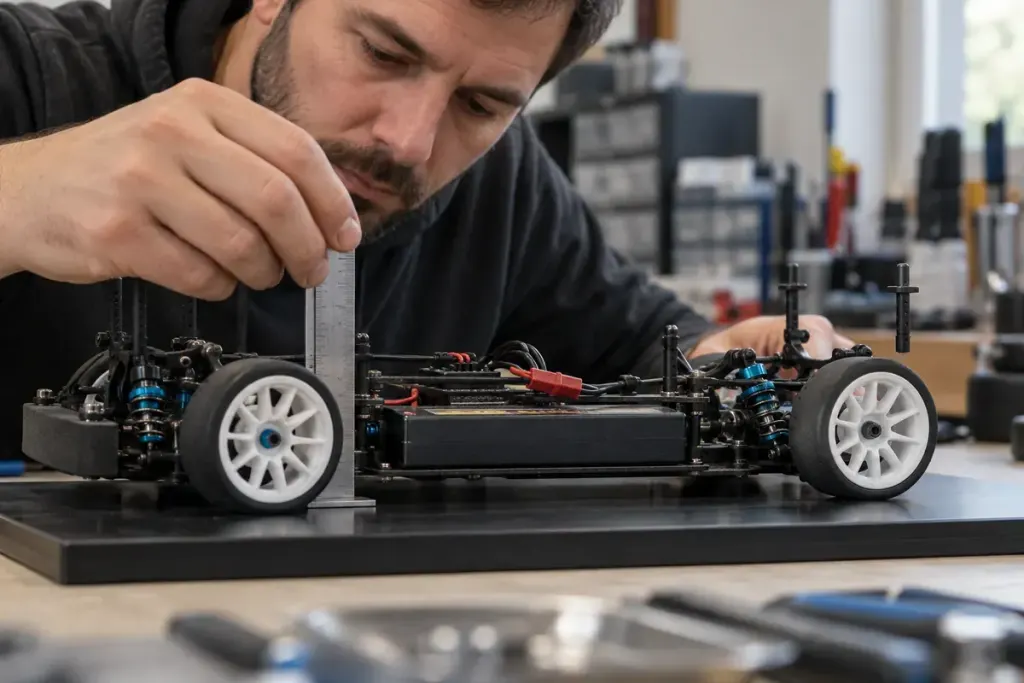
You set the chassis clearance on an empty car, install the battery and find that the measurement has changed. The suspension is supporting a different load. For a useful setup record, measure the car in the configuration the manufacturer’s setup procedure specifies.
On an electric car, that normally means accounting for the correct battery and other running equipment. For example, Tekno RC’s SCT410SL instructions (PDF, page 26) specify measuring with the battery installed and body on. The detailed method and target belong to that model. Keep the vehicle powered off and follow the model’s battery-handling instructions. Do not connect a live drivetrain simply to measure clearance.
Make the measurement repeatable
Use a flat setup surface and the measuring points specified for the chassis. Install the intended wheels and tyres, secure the battery in its normal position and settle the suspension as directed. A pack resting loosely on top of the chassis is not equivalent to its proper mounting position.
Read the clearance with an appropriate ride-height gauge without lifting the car as the gauge slides beneath it. Record front and rear values separately, along with the tyres and battery arrangement. The number is easier to interpret when the setup that produced it is recorded beside it.
Do not confuse ride height with suspension droop. Ride height describes the settled chassis clearance; droop concerns available downward wheel travel. Changing one measurement does not automatically establish the other.
Change the setting, then measure again
Use the adjustment method in the model’s manual. After a change, settle and remeasure both ends rather than assuming that a turn of an adjuster produced a particular clearance. Check that nothing binds or sits incorrectly.
For an invented comparison, a driver switches to a heavier approved battery and repeats the measurements before testing. That separates a load-related change from a later suspension adjustment.
There is no universal clearance that suits every RC car or surface. Start from the manufacturer’s baseline and track guidance appropriate to the model. The first goal is not the lowest possible car; it is a measurement that means the same thing each time you compare it.